

Pink Floyd in Formentera: the facts and the legend
Did Pink Floyd visit Formentera? We look at how much of the story is true, what is legend and what the island that attracted so many artists in the late 1960s was like.
Pink Floyd in Formentera: what we know
A great deal has been said about the link between Pink Floyd and Formentera. Some tell it as a hippie getaway, others claim the island inspired their music. What is documented is that, in the summer of 1967, Syd Barrett travelled to Formentera to rest, at a time when his mental health was already starting to suffer. He was accompanied by Rick Wright, their partners and the British doctor Sam Hutt, who years later would become known as a country musician under the name Hank Wangford. Nick Mason has said that Roger Waters went too, although other sources place him in Ibiza. The idea was to get Syd away from London but, as Mason himself admitted, they understood very little about what was happening to him and the trip did not help much.
Around the same time, Aubrey “Po” Powell, co-founder of Hipgnosis, the studio that designed many of the band’s album covers, also discovered the island. His bond with Formentera was such that in 2008 the island hosted the first exhibition in Spain of Hipgnosis covers.
Beyond that, there are plenty of stories doing the rounds (what they did, who they met, what evenings they shared) that are not documented. We take them for what they are: part of the island’s legend.
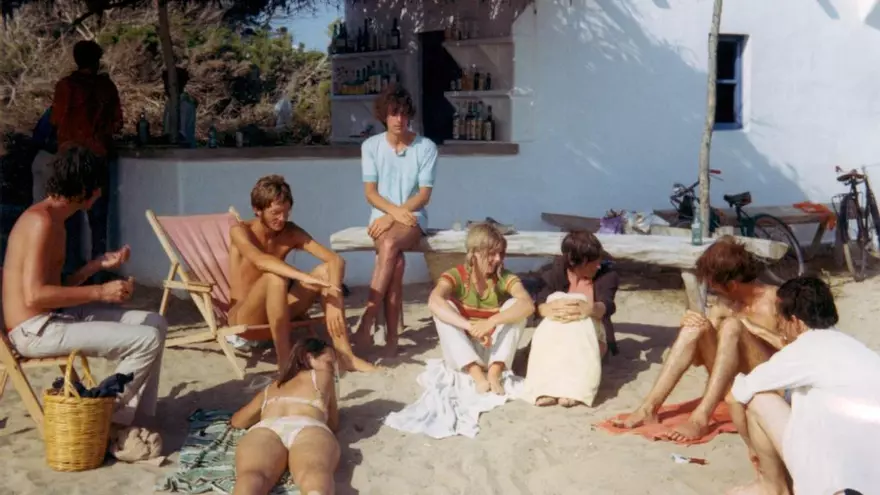
The founding members of Pink Floyd with some of their partners on Migjorn beach in 1967. Photo: L. Cornor / Diario de Ibiza
Did Pink Floyd record anything in Formentera?
No. The band’s clearest musical link with the Pitiusas is More, the soundtrack they wrote for the film of the same name, Barbet Schroeder’s first feature, shot mainly in Ibiza. The album was recorded in London, at Pye Studios, in January and February 1969, and released in June that year.
Many people like to imagine that Formentera’s light, sea and calm influenced their sound, but there is no evidence at all. It is, above all, a lovely idea.
Formentera in the 1960s
To understand why musicians and artists came all the way here, you have to picture the island as it was then: a subsistence economy living off farming, fishing and salt, which could only be reached by sea. That isolation turned it, in the 1960s and 70s, into a magnet for artists and countercultural travellers, and the island became forever linked with the hippie era.
Formentera today: the same sense of calm
Today many visitors are looking for the same thing as those travellers: to get away from the noise and find some silence. Some do it by exploring the island on foot or by bike. Others prefer the sea. Boat hire in Formentera offers exactly that: a way to experience the island calmly and at your own pace, stopping for a swim in quiet coves or off the long Migjorn beach.
Myth or reality, it does not matter
In the end, what matters is not whether everything people say is true. What matters is that Formentera is still a place where you can switch off, create and think. And that is already a lot.

